i'm doing a repost of the mini-reviews i made at PinoyDVD...
so, read on.
Tuesday, March 27, 2007

thirteen days

Thirteen Days - Roger Donaldson
Thirteen Days retells of the thirteen fateful days during the Cuban Missile Crisis of 1962 wherein the world braced itself for a would-be nuclear standoff between USA and USSR. It's not so much of a political thriller, but it borders on it anyway, taking the liberty of distorting an iota of historical fact in order to give a sense of camp entertainment. Kevin Costner stars as Kenneth O' Donnell, the Special Assistant to JFK, a man whose job is to keep his president on the right track even if means covering up JFK's mistakes. However the film portrays the Kennedys and O'Donnel a good light contrary to Seymour Hersh's expose of their malevolent deeds in his book The Dark Side of Camelot. Anyway, the movie somehow manages to vindicate them of what Hersh had revealed, but it in some way presents their weakness--a terrible muddle in decision making that nearly put the situation out of hand. Bruce Greenwood plays a believable JFK, and Steven Culp's RFK justifies what the man was to his older brother. Costner, beyond the phony Boston accent and the role O'Donnell played during the crisis (which plenty of historians rebuffed saying O'Donnell didn't even give a damn about the events) redeems him of his previous cinematic failures. Thirteen Days is an entertaining political/historical thriller that deserves even a single peek.
Friday, October 27, 2006
litpick: Codex

Codex - Lev Grossman; Harcourt Books Publishers 2004
The Da Vinci Code sans Dan Brown and...everything in it, I guess. While Brown's book is the GoNuts-DoNuts (as Dodo would put it) of the literary scene, this one is far below the level of, even, Mister Donuts. The one that you'd consider as that sugar-sprinkled concoction found in glass partitions of local bakeries, wishing some famished carcass would liberate them with their few hard-earned currency. Simply put, it is not that would rocket up the list of a National Bookstore nor PowerBooks bestseller list. Nevertheless, I'll personally elevate it there. Lev Grossman, an unknown dude to the majority of the reading public--except for those who consider Time Magazine as part of their daily news intake---wrote this 'perfectly-okay' novel as his contribution to the growing number of rip-offs Dan Brown's book had amassed. However, the turnout is, in my opinion, a lot better. It tells of a yuppie banker Edward Wozny tasked by a uber-wealthy client to catalog their collection of old books and at the same time dig through the dirt-crusted chests of a codex that nobody believed existed. From thereon the plot weaves through the a fictional medeival history of the author, allusions to Chaucer and a subplot on a Myst-like PC game that Edward found himself addicted to. Yep, it's Da Vinci code minus the know-it-all attitude of Langdon (Wozny's failure to grasp history as well as his ephemerality is quite...um, realistic); sans the car-chases; and an antagonist that exists only if you would categorize him/her as one. It's an intelligent thriller. And it'll keep you stuck to your seat for a few hours a day, at least.
Wednesday, July 19, 2006
Kyoshi Kurosawa's KYUA (Cure)

KYUA (english title: CURE)
Directed by: Kiyoshi Kurosawa
Screenplay: Kiyoshi Kurosawa (based on novel)
Copyright 1997
Cast: Koji Yakusho, Anna Nakagawa, Masato Hagiwara
With the release of Hideo Nakata’s Ringu (Ring, 1998) and its succeeding sequel here in the Philippines, viewers immediately lunged to grasp the cinematic ingenuity of Japanese directors in their near-convincing manipulation of the horror genre. Ring created the ambience of pure terror into the hearts of the viewing public—and unintentionally junked its Hollywood remake. Evidently, the advent of Japanese cinema among the Filipinos manifested a clear meaning: we are not cinematic morons as many perceived us to be.
Clearly, this statement is also indebted to Kiyoshi Kurosawa as the feature director for the month-long annual Eiga Sai Film Festival held at the Shangri-La Cinema, the CCP and the UP Film Center. Although it would only run for the entire March, the festival’s feature film is the psychological suspense thriller, KYUA (CURE). With this, Kurosawa was typed as a horror-auteur, succeeding Kyua with two more films of the same genre: Korei (Séance) and Kairo (Pulse). His name might be similar to the great filmmaker Akira Kurosawa who lifted the prevarication of the Japanese cinematic proficiency by bringing The Seven Samurais, Ran, Rashomon, The Hidden Fortress to global audience. It is in this sense that I surmise that the name Kurosawa is, if not, indirectly associated to the word Cinema, though there exists no sanguinary relation between the two.
Anyway, KYUA is admittedly, an intellectual horror. What lack visually is compensated by the screenplay itself. The plot revolves around a series of gruesome murders—its methods tangibly connected (leaving an X mark on different parts of the body), those apprehended were either the victims’ loved ones, colleagues or friends and although they admit being the ones who perpetrated the deed, their recollection of why they did it seemed to have lost in their consciousness. Enter police detective Takabe Ken-ichi (Koji Yakusho) who from the start of the investigation deftly surmised that a hypnotic trance carried the perpetrators into the grotesque reality of murder. Apparently, it turned out to be the work of an eccentric wanderer (Makoto Hagiwara)—whose real identity we wouldn’t know of until the latter part of the film. The arrival of this mysterious character challenged (but didn’t contest) Takabe’s claim of a possible hypnosis scenario, but rather attempted to see what behind the detective’s persona. The anticlimactic yet frightening denouement that reminded me of the conclusion of Twin Peaks is somewhat delicately interpreted though one could sense and notice the similarity between the two. Also, if one would notice the style Kurosawa adopted, it would be that of the prosaic touch mastered and perfected by the suspense meister Alfred Hitchcock.
If one would be asked on his/her reaction towards the film, they would probably claim that there are plenty of unnecessary scenes that needed adequate and thorough exposition. Kurosawa leaves such questions to the audience—for them to search for the answers and the explanations. Perhaps it is in this light that the movie deserves a second serving—a means of a visual laxative for the mental quench aggregated by a subtle psychological distress brought forth by an intensive miscomprehension of the film’s plot. Complicated though, but with the success of Ringu and its succeeding sequels on the Philippine moviegoing society, Cure could simply be an abrupt dose to the effects brought by Sadako.
Technically, Cure is a cinematic near-perfection: a delivery of an appropriate soundtrack that I could associate a Bernard Herrmann or an Ennio Morricone; Kurosawa’s screen shots made me reminisce of a “Babad” shot as explained by Filipino movie director Lore Reyes—which involves a mere panning of camera on a certain setting without any cuts and editing whatsoever. Kurosawa’s filmic reality, meanwhile lies according to the prosaic grounds of basic filmmaking, exuding the common processes of editing yet stylish in numerous instances (the “Babad” shot for example)—which often reminds me of Sergei Eisenstein in Battleship Potemkin or Robert Altman’s The Player.
While CURE may have lacked the Sadako-esque horror that most viewers would have probably anticipated, it delves deeply into the realms of the human psyche—the characterization of what is terrifying is subtly represented. Koji Yakusho’s portrayal of Takabe is similar to Kyle MacLachlan’s detective in David Lynch’s Twin Peaks. And from this point, I could also notice the poignant traits and the Lynch-esque perspective that Kurosawa may have adopted and skillfully modified. Makoto Hagiwara’s portrayal of the eccentric wanderer niftily put the mystery into the person responsible for the brutal deeds—and his incessantly-reiterated question of “Who are you?” added to the weight of mystery and terror into the development of both the storyline and the characters being groomed. Basically, as the film progresses into the climax and its gradual denouement, we are also treated to the same question repeatedly uttered by one of the characters. It is a query of our capability to understand the film better or are we just the same beings before and after we viewed the film. It is also a question that challenged our mental capacities into believing that it is only a movie—nothing more, nothing less—but somehow the situations presented justified the reality of something unfathomable. Hence, our existence as rational human beings is fundamentally what Kurosawa is trying to explain.
In the large spectrum of things, CURE tells of the vast possibilities the human psyche could (in some way) attain—whether it could lead to something sinister or not. It is a film that many people considered horror, but it tackles reality with twisted portrayals and mild exaggerations. Technically, Kurosawa’s camera works and cinematography made it extremely horrifying, nevertheless.
As a parting word, CURE is a manifestation of Kiyoshi Kurosawa’s brilliant vision and pen—and perhaps what we could refer to as the laxative that treated the recurring spells brought forth by Hideo Nakata and Sadako.
Saturday, April 15, 2006
breaking news
from my post in pinoydvd:

Breaking News - Johnnie To
I'm not really fond of Hong Kong crime films until a friend introduced me to Johnnie To. I've seen a couple of his films in Star Mandarin back then (if i remember t'was Running Out of Time 2 and Fulltime Killer) but didn't paid much interest. Recently, I blind-bought Breaking News, which i heard from that same acquaintance that it was shown at Cannes. Tried it. Liked it. However found the plot as shallow as most Hollywood action flicks tend to be. The action sequences are heavy, right from the start and towards its predictable payoff. The cast are fine, except that he should have casted those that rotated on much of his previous crime dramas (Andy Lau, Tony Leung, Lau Ching-Wan) and give the film certain credibility on how its entirety should be played. Anyway, the gunbattles compensated for To's miscast but I think the ultimate lowdown of the film is its finale---something i believe is a total opposite of how a majority of crime/triad films are resolved. I'd rather see an ambiguous resolution than the usual 'crime does not pay' cliche. I wouldn't complain. To's the master of crime/triad entertainment and to that, he didn't fail on this one.
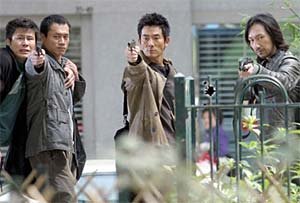
Breaking News - Johnnie To
I'm not really fond of Hong Kong crime films until a friend introduced me to Johnnie To. I've seen a couple of his films in Star Mandarin back then (if i remember t'was Running Out of Time 2 and Fulltime Killer) but didn't paid much interest. Recently, I blind-bought Breaking News, which i heard from that same acquaintance that it was shown at Cannes. Tried it. Liked it. However found the plot as shallow as most Hollywood action flicks tend to be. The action sequences are heavy, right from the start and towards its predictable payoff. The cast are fine, except that he should have casted those that rotated on much of his previous crime dramas (Andy Lau, Tony Leung, Lau Ching-Wan) and give the film certain credibility on how its entirety should be played. Anyway, the gunbattles compensated for To's miscast but I think the ultimate lowdown of the film is its finale---something i believe is a total opposite of how a majority of crime/triad films are resolved. I'd rather see an ambiguous resolution than the usual 'crime does not pay' cliche. I wouldn't complain. To's the master of crime/triad entertainment and to that, he didn't fail on this one.
Subscribe to:
Posts (Atom)